

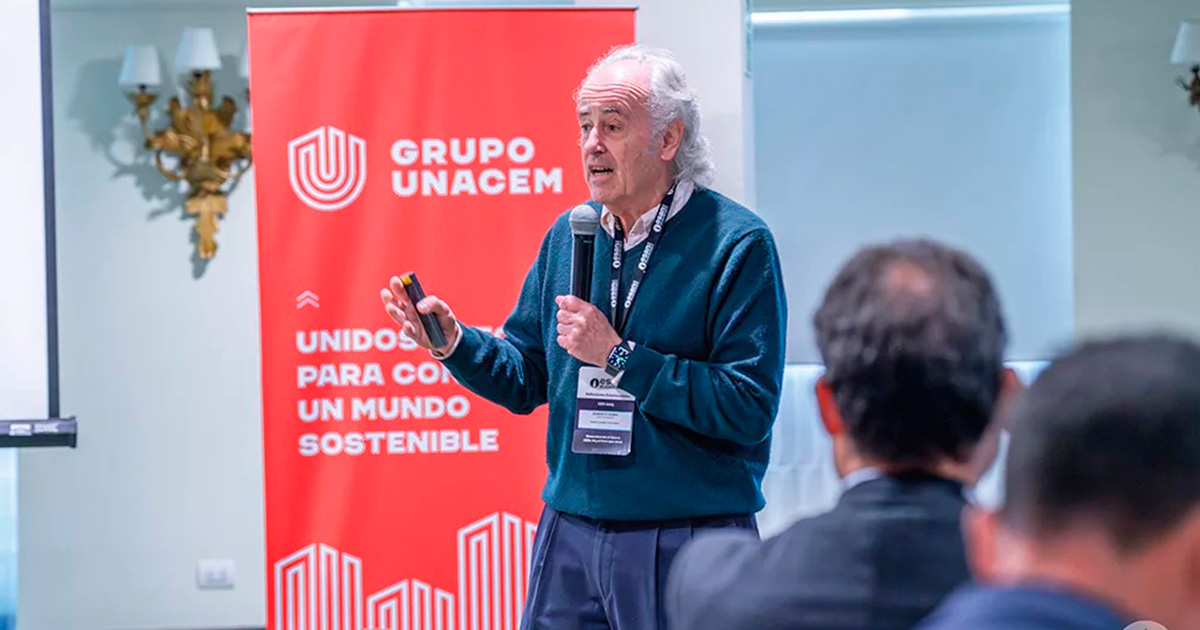
An orchestra conductor leads the musicians under their direction to recreate a composer’s work in the most appropriate way. Roberto Serra, a leading business strategy expert in Latin America and speaker at the conference “CEO Business Reflections 2025: Rewriting the Future: CEOs, AI and Peru” organized by ESAN Graduate School of Business, explains that this discipline contains lessons that can help business leaders navigate a landscape shaped by economic uncertainty and the rapid acceleration of digital transformation.
You have worked with leaders from different sectors, in turbulent and transformative contexts. If we think of a company as an orchestra, which elements of that metaphor are most revealing for understanding the leader’s role today?
The ability to work together—just as in orchestras. If each musician plays a different melody, the orchestra will sound bad. In a company, if each department works on its own, in isolation, it is impossible to achieve good results.
In an environment where artificial intelligence automates decisions and tasks, what role remains for the human orchestra conductor?
Artificial intelligence provides us with a great deal of data, but humans can generate other elements that are essential to an organization—often more important than information itself. That is why leaders must be well prepared and commit to transdisciplinarity, meaning the ability to understand multiple disciplines in order to clearly define direction, inspire others, and create proposals that stand apart. If we let artificial intelligence take command of the orchestra, we will get a robotic sound—without sensitivity or passion—incapable of conveying what the composer intended.
Do you think economic and political crises function as a kind of harmonic dissonance that could enrich a company’s melody?
A crisis can be understood as a dissonance that may ultimately be positive for a company, if it is handled well. Crises generate bifurcation points where growth becomes possible if disruptive change is driven. In chaos theory, they say: “You either go toward death or you grow.” In Silicon Valley, that bifurcation point is called the valley of death. Crises are important precisely because they help overcome that valley.
You mentioned earlier that the companies that survive are not the strongest, but the fastest. How do you accelerate an orchestra without the musicians losing the beat?
In music, accelerandos, glissandos, and other elements are usually written into the score, so accelerating without losing the beat is not difficult. It is the conductor who guides the orchestra along that path. It is probably much easier in music than in business.
“Our company has to start seeking disruptive elements—always and on its own initiative.”

In your view, what are the most underestimated skills a CEO needs today to keep the rhythm without becoming a tyrant with the baton?
That tyrant with the baton should never exist. Today, leaders cannot simply give orders or control everything. We must work based on self-organization. The leader’s role is to bring people together and inspire passion and the desire to work collectively in order to generate resonance. The internal and external system changes completely depending on the leader’s strength. We need holistic, inspiring leadership that points the way forward.
In times of crisis, many companies cut budgets for innovation, training, or organizational culture. How dangerous is this cut for the orchestra’s long-term sound?
These are very dangerous, abrupt moves, often driven by brute force. In some cases, components that will not be needed in the future may be eliminated, but in most cases, such cuts produce negative results for companies.
We live in times where disruption is the rule. How do you train a business “ear” to distinguish a true signal of change from passing noise?
First, rather than searching for signals or noise, it is important to think about how to generate disruption ourselves. Second, we must stay attentive to determine whether we are facing a signal or just noise. If it is a signal, we have to lead the change—that is what disruption is about. Our company must constantly seek disruptive elements on its own initiative. If it becomes stagnant and lacks the courage to take risks, it is very likely to end up losing.
With the risk that artificial intelligence may give us flawless melodies without soul, how can a company avoid becoming an automatic player instead of a living orchestra?
A company must be led by a broad group of people—not only from the top, and not by artificial intelligence alone. We must always remember that it is we—the people who work there—who give the organization life and, above all, the passion that artificial intelligence will never be able to replicate
Source: https://stakeholders.com.pe/noticias-sh/que-lecciones-de-liderazgo-empresarial-podemos-extraer-de-la-direccion-orquestal/